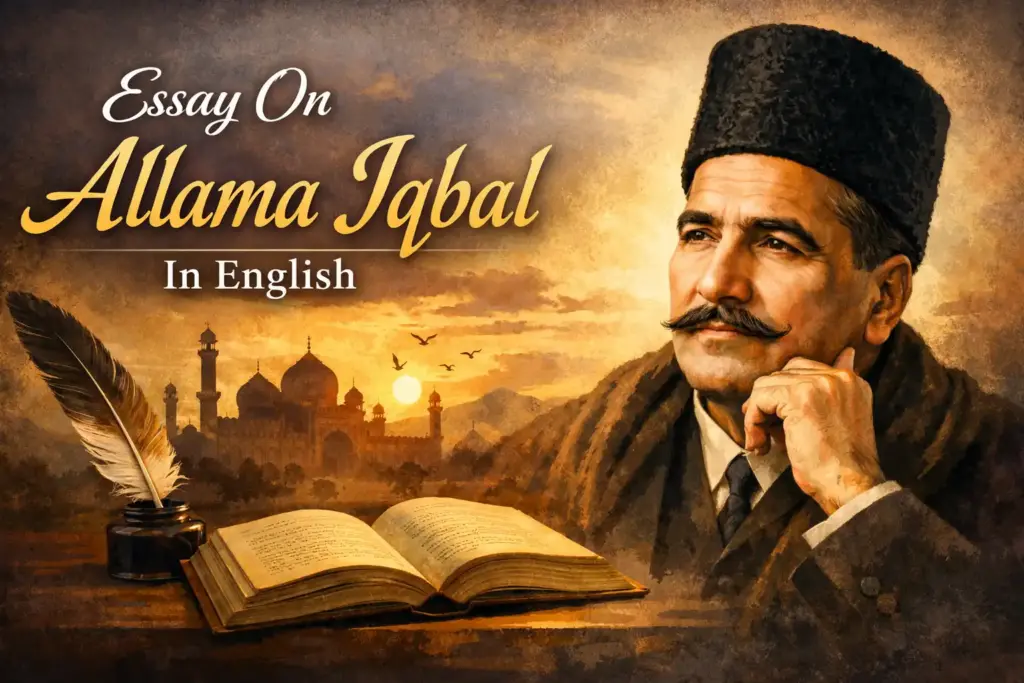
Essay On Allama Iqbal In English
In 2026, students across South Asia and beyond continue to struggle with questions of identity, purpose, self-worth, and the role of faith in a rapidly changing world. Education systems often focus on technical skills but leave young minds searching for meaning, moral direction, and confidence in their cultural roots.
This is exactly where Allama Muhammad Iqbal becomes more than a historical figure, he becomes a solution. His poetry, philosophy, and political vision provide practical guidance for self-development, social reform, and intellectual awakening.



Allama Iqbal at a Glance
Before exploring his life and contributions in depth, here is a quick factual overview:
| Category | Details |
|---|---|
| Full Name | Sir Muhammad Iqbal |
| Known As | Allama Iqbal, Poet of the East |
| Date of Birth | November 9, 1877 |
| Place of Birth | Sialkot, Punjab (British India) |
| Date of Death | April 21, 1938 |
| Nationality | Indian (pre-1947), Spiritual Father of Pakistan |
| Professions | Poet, Philosopher, Politician, Lawyer |
| Famous Titles | Poet of the East, Thinker of Islam |
| Major Languages | Urdu, Persian, English |
Childhood Roots and the Making of a Thoughtful Mind
Allama Iqbal was born in Sialkot into a deeply religious and disciplined family. His father, Sheikh Noor Muhammad, was a humble tailor known for his spiritual wisdom, while his mother, Imam Bibi, was admired for her kindness and moral character. From an early age, Iqbal was exposed to Islamic teachings, Persian poetry, and classical literature, which shaped both his emotional depth and intellectual curiosity.
As a child, Iqbal showed exceptional talent in memorization and expression. His teachers quickly recognized his potential, especially his mentor Syed Mir Hassan, who introduced him to Arabic, Persian, and classical philosophy. Unlike many students of his time, Iqbal did not memorize knowledge passively. He questioned ideas, analyzed meanings, and tried to connect learning with real life. This habit of critical thinking later became the foundation of his philosophical poetry and reformist thought.
Academic Excellence and Intellectual Growth Abroad
Iqbal’s educational journey reflects his lifelong commitment to learning and intellectual development. After completing his early studies in Sialkot, he moved to Lahore, where he earned his Bachelor’s and Master’s degrees in philosophy from Government College University. His academic brilliance soon earned him scholarships and international recognition.
In 1905, Iqbal traveled to Europe for higher studies. He studied philosophy at Cambridge University, qualified as a barrister from Lincoln’s Inn in London, and earned his doctorate from the University of Munich in Germany. His doctoral thesis focused on Persian metaphysics, revealing his deep engagement with Eastern and Western philosophical traditions.
During his stay in Europe, Iqbal closely observed Western civilization, democracy, capitalism, and nationalism. While he admired the West’s scientific progress and discipline, he also recognized its moral emptiness and spiritual crisis. This contrast deeply influenced his later works, where he emphasized the need for spiritual revival alongside material advancement. His time abroad transformed him from a poet into a philosopher of civilization and reform.
The Birth of a Poet Who Spoke to the Soul
Iqbal’s poetic career began with romantic and patriotic poetry, but soon evolved into spiritual, philosophical, and revolutionary expression. He believed poetry was not merely for entertainment but a powerful instrument for awakening nations and reshaping thought.
His early Urdu poems expressed love for nature, cultural pride, and emotional sensitivity. However, as his thinking matured, his poetry became bold, visionary, and deeply transformative. He began addressing issues such as selfhood, freedom, faith, decline of Muslim civilization, and the destiny of humanity. His poetry challenged individuals to rise above fear, dependency, and hopelessness.
Iqbal wrote extensively in both Urdu and Persian, believing Persian allowed him to communicate with the wider Muslim world, while Urdu connected him emotionally with the people of the Indian subcontinent. His words continue to inspire millions across generations because they speak directly to the human soul, not merely to historical circumstances.
Understanding Khudi: Iqbal’s Philosophy of Selfhood
One of the most powerful concepts in Iqbal’s thought is Khudi, often translated as “selfhood” or “ego.” However, in Iqbal’s philosophy, Khudi does not mean arrogance or selfishness. Instead, it refers to the development of inner strength, self-awareness, moral responsibility, and spiritual consciousness.
Iqbal believed that individuals who recognize their true worth and divine purpose become fearless, creative, and independent. According to him, nations decline when individuals lose confidence, dignity, and moral clarity. Therefore, he encouraged youth to cultivate discipline, courage, knowledge, faith, and action.
In modern terms, Iqbal’s concept of Khudi closely aligns with personal development, leadership training, and character education. In 2026, when young people face anxiety, identity confusion, and purpose crises, Iqbal’s message of self-discovery and spiritual empowerment feels more relevant than ever.
Major Literary Works and Their Lasting Influence
Allama Iqbal’s literary contributions shaped intellectual movements across South Asia, the Middle East, and beyond. His works blend Islamic spirituality, philosophy, history, and poetry into a powerful narrative of renewal and hope.
Some of his most influential works include:
| Book/Poem | Language | Theme |
|---|---|---|
| Bang-e-Dra | Urdu | National awakening, spiritual growth |
| Bal-e-Jibril | Urdu | Faith, revolution, selfhood |
| Zarb-e-Kalim | Urdu | Social reform, critique of materialism |
| Asrar-e-Khudi | Persian | Philosophy of selfhood |
| Rumuz-e-Bekhudi | Persian | Community and collective life |
| Javid Nama | Persian | Spiritual journey, destiny of humanity |
These works continue to be taught in schools and universities in 2026 because they provide timeless insight into ethics, leadership, identity, and civilization. His poetry is not confined to literary beauty alone; it functions as a roadmap for intellectual revival and moral reconstruction.
Allama Iqbal as a Thinker of Islamic Renaissance
Iqbal did not see Islam merely as a religion of rituals but as a dynamic force capable of guiding civilization. He strongly opposed blind imitation of tradition and equally criticized unthinking adoption of Western materialism. Instead, he advocated for ijtihad, independent reasoning within Islamic principles, to address modern challenges.
In his lectures, later published as The Reconstruction of Religious Thought in Islam, Iqbal presented Islam as a progressive, rational, and spiritually alive system capable of adapting to new realities. He believed Muslims had lost political power not because of fate but because they abandoned knowledge, action, and moral courage.
His thought inspired educational reform, intellectual revival, and political awareness throughout the Muslim world. Even in 2026, scholars continue to analyze his ideas to address issues such as extremism, identity crisis, governance, and ethical leadership.
Political Vision and the Dream of a Muslim Homeland
While Iqbal is primarily remembered as a poet and philosopher, his political contributions were equally transformative. He actively participated in Indian politics and served as a member of the Punjab Legislative Council. However, his most historic contribution came in 1930 when he delivered his presidential address at the Allahabad session of the All-India Muslim League.
In that address, Iqbal proposed the idea of a separate Muslim state in the northwestern regions of India. His vision was not merely territorial but spiritual and cultural. He believed Muslims needed a political environment where they could freely practice their values, develop their culture, and contribute ethically to global civilization.
Though Iqbal passed away in 1938, nearly nine years before Pakistan’s creation, his philosophical groundwork deeply influenced Muhammad Ali Jinnah and the Pakistan Movement. As a result, Iqbal is honored today as the Spiritual Father of Pakistan, a title that remains meaningful in 2026.
Relationship with Youth and Educational Reform
Iqbal placed extraordinary emphasis on youth. He believed young people were the true architects of civilization and the carriers of moral transformation. His poetry frequently addresses students, urging them to reject laziness, fear, imitation, and despair. Instead, he encouraged curiosity, courage, discipline, and independent thinking.
In 2026, educational institutions continue to use Iqbal’s writings in character-building programs, leadership training, and moral education curricula. His belief that education should produce thinkers rather than followers resonates strongly in today’s world, where critical thinking and ethical awareness are essential for responsible citizenship.
Iqbal’s message to youth remains timeless: rise above limitations, trust your inner strength, and work for the betterment of humanity, not just personal success.
Personal Life, Character, and Values
Despite his fame and influence, Allama Iqbal lived a relatively simple life. He practiced law professionally but never allowed material success to dominate his purpose. He was known for his humility, discipline, and deep spiritual reflection. His personal struggles, including illness, loneliness, and financial pressure, never weakened his commitment to intellectual service.
Iqbal married twice and had children, including his son Javid Iqbal, who later became a respected jurist and scholar. His home life was marked by intellectual discussion, literary creativity, and moral discipline. Those who met him described him as thoughtful, soft-spoken, and deeply introspective.
His character embodied the very ideals he preached: sincerity, courage, dignity, and service to humanity.
Awards, Honors, and Recognition
Iqbal received widespread recognition during his lifetime and posthumously. In 1922, the British government awarded him the title of Sir, acknowledging his literary and intellectual achievements. However, he remained more concerned with moral impact than formal titles.
After Pakistan’s creation, his status rose further as his vision became reality. Today, his legacy is preserved through:
| Recognition | Description |
|---|---|
| Iqbal Day | Celebrated annually on November 9 |
| Iqbal Academy Pakistan | Research and publication institute |
| Educational Institutions | Universities, colleges, and schools named after him |
| Currency & Monuments | His image appears on currency notes and statues |
| National Poet Status | Officially recognized in Pakistan |
In 2026, digital platforms, academic research, and cultural festivals continue to expand his influence across the globe.
Allama Muhammad Iqbal was not merely a poet, philosopher, or political thinker. He was an architect of consciousness, a reformer of minds, and a guide for civilizations in transition. His life story reflects intellectual struggle, spiritual depth, and unwavering commitment to human dignity. His poetry awakens courage, his philosophy nurtures selfhood, and his political vision reshapes history.

This is a good information