Why Pakistani Students are Weak in English?
English proficiency among Pakistani students remains a significant challenge. Pakistan’s national language is Urdu, and for most students, English is not their mother tongue. Naturally, learning a language that is not spoken at home can be difficult. Despite English being an official language in Pakistan, it is not effectively promoted at the primary and initial education levels, which contributes to students’ struggles in both speaking and writing English.
Lack of Early English Education
One of the primary reasons Pakistani students are weak in English is that many local primary schools do not teach English as a compulsory subject. Language learning starts from the foundation, and if students grow up learning primarily in Urdu, it becomes increasingly difficult to develop a strong grasp of English later.



Transforming Urdu-medium schools into English-medium institutions from the early stages of education can significantly improve students’ comfort and confidence with the language. Early exposure allows students to adapt naturally to English, helping them perform better in academics and professional environments where English is required.
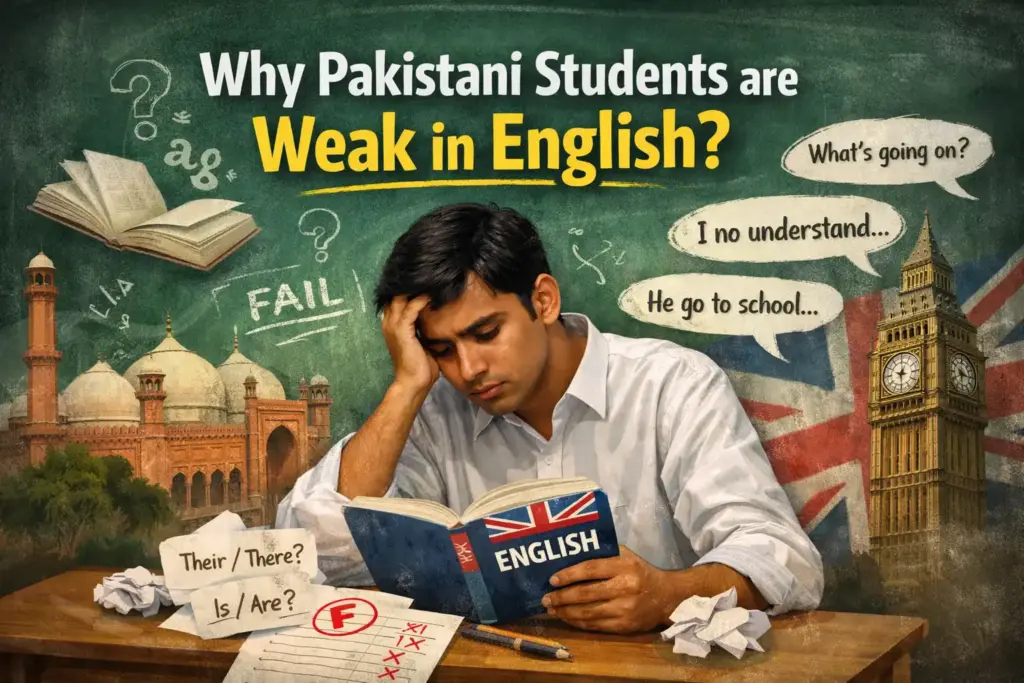
Low Confidence in Speaking English
Another major factor contributing to the weakness in English among Pakistani students is lack of confidence. Many students feel hesitant and discouraged while trying to speak or write English due to limited practice and support. This lack of confidence often leads to fear of making mistakes, which further reduces their willingness to engage with the language.
When students face criticism or mockery from peers while speaking English, it demotivates them from trying again. This social discouragement exacerbates the problem, making English learning an intimidating task instead of a skill they can confidently develop.
The Way Forward
To overcome these challenges, Pakistan must:
-
Introduce English at the primary level in all schools.
-
Encourage English-speaking practice in classrooms without fear of ridicule.
-
Provide teacher training to improve the quality of English education.
-
Promote English literacy programs outside school to build confidence.
By focusing on early education, consistent practice, and a supportive learning environment, Pakistani students can gradually overcome their weaknesses in English and achieve fluency in both spoken and written English.
