Future Perfect Tense In Urdu And English Example Exercise Formula
You will not only understand what Future Perfect Tense is, but you will also learn how to form it correctly in English and Urdu, use it naturally in real-life situations, avoid common mistakes, and practice with modern examples and exercises. By the end, you will confidently use this tense in speaking, writing, exams, and everyday conversations.
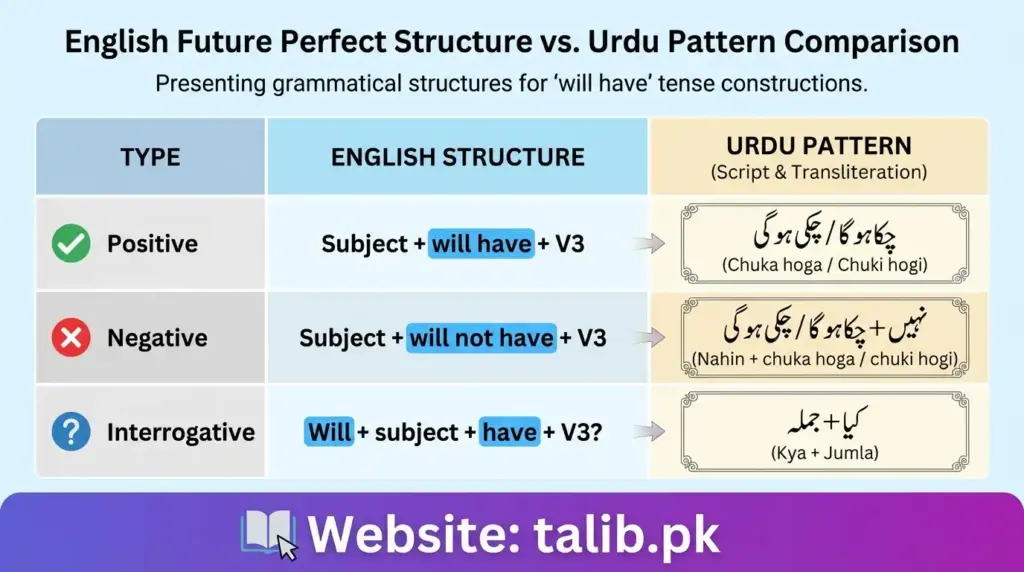
Quick Reference Table for Future Perfect Tense
| Type | English Structure | Urdu Pattern |
|---|---|---|
| Positive | Subject + will have + V3 | چکا ہوگا / چکی ہوگی / چکے ہوں گے |
| Negative | Subject + will not have + V3 | نہیں + چکا ہوگا / چکی ہوگی |
| Interrogative | Will + subject + have + V3? | کیا + جملہ |
This table helps learners revise quickly before exams or speaking practice.





What Is Future Perfect Tense Explained Simply
Future Perfect Tense is used to describe an action that will be completed before a specific time in the future. It connects three time ideas:
- The present moment
- A future deadline
- A completed action before that deadline
For example:
She will have finished the report by 5 PM.
Here, the finishing happens before 5 PM, which is in the future.
In Urdu, the same idea is expressed as:
وہ شام پانچ بجے تک رپورٹ مکمل کر چکی ہوگی۔
This tense does not focus on the action itself, but on the completion of the action before a future time point.
Future Perfect Tense Formula in English
The structure of Future Perfect Tense is simple and consistent across all subjects.
English Formula
Subject + will have + past participle (V3) + object/time
Examples:
- I will have completed my homework by tonight.
- She will have left the office before sunset.
- They will have built the house by next year.
This structure never changes, whether the subject is singular or plural.
Future Perfect Tense Formula in Urdu
In Urdu, Future Perfect Tense is usually expressed using:
Subject + object + verb (چکا ہوگا / چکی ہوگی / چکے ہوں گے)
The helping verb changes based on gender and number.
Examples:
- میں اپنا کام مکمل کر چکا ہوں گا۔
- وہ کتاب پڑھ چکی ہوگی۔
- وہ امتحان پاس کر چکے ہوں گے۔
Unlike English, Urdu reflects gender and number agreement, which learners must pay attention to.
Future Perfect Tense in Positive Sentences
Positive sentences in this tense emphasize that an action will definitely be completed before a future time.
Examples in English:
- I will have finished the assignment by evening.
- She will have reached home before midnight.
- They will have saved enough money by next year.
Examples in Urdu:
- میں شام تک اسائنمنٹ مکمل کر چکا ہوں گا۔
- وہ آدھی رات سے پہلے گھر پہنچ چکی ہوگی۔
- وہ اگلے سال تک کافی پیسے بچا چکے ہوں گے۔
These sentences are commonly used in academic planning, professional goals, and personal commitments.
Future Perfect Tense in Negative Sentences
Negative sentences express that an action will not be completed before a future time.
English Structure
Subject + will not have + past participle
Examples:
- I will not have completed the work by tomorrow.
- She will not have arrived before noon.
- They will not have saved enough money by next year.
Urdu Structure
Urdu uses negation words like نہیں with the same tense markers.
Examples:
- میں کل تک کام مکمل نہیں کر چکا ہوں گا۔
- وہ دوپہر تک نہیں پہنچی ہوگی۔
- وہ اگلے سال تک کافی پیسے نہیں بچا چکے ہوں گے۔
This form is useful when discussing delays, obstacles, or unmet expectations.
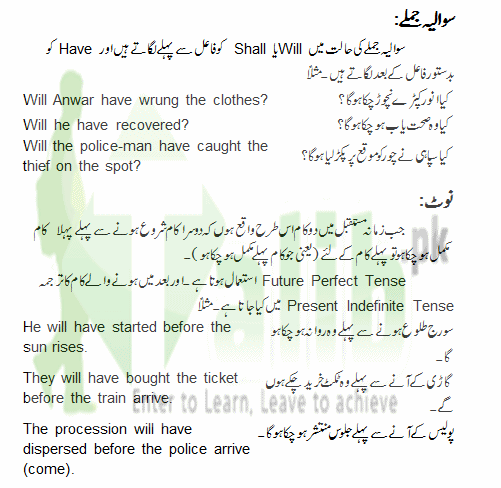
Future Perfect Tense in Interrogative Sentences
Questions in this tense are used when asking about future completion.
English Structure
Will + subject + have + past participle + object/time?
Examples:
- Will you have finished your work by tonight?
- Will she have reached home before sunset?
- Will they have completed the project by next month?
Urdu Structure
Urdu questions are usually formed by tone or question words.
Examples:
- کیا تم آج رات تک اپنا کام مکمل کر چکے ہوگے؟
- کیا وہ سورج غروب ہونے سے پہلے گھر پہنچ چکی ہوگی؟
- کیا وہ اگلے مہینے تک منصوبہ مکمل کر چکے ہوں گے؟
These forms are commonly used in planning meetings, exams, and interviews.
Common Time Expressions Used with Future Perfect Tense
Future Perfect Tense often works with specific time expressions that indicate a deadline or endpoint.
| Common Time Expressions | Example |
|---|---|
| by tomorrow | I will have completed the task by tomorrow. |
| by next week | She will have prepared everything by next week. |
| before evening | They will have left before evening. |
| by the time | By the time you arrive, I will have cooked dinner. |
| in two hours | He will have finished the work in two hours. |
In Urdu, similar expressions are used:
- کل تک
- اگلے ہفتے تک
- شام سے پہلے
- جب تک
- دو گھنٹوں میں
These phrases help clearly define the future completion point.
Future Perfect vs Simple Future Explained Clearly
Many learners confuse Future Perfect Tense with Simple Future Tense, but their meanings are different.
| Tense | Purpose | Example |
|---|---|---|
| Simple Future | Talks about future action | I will complete the work. |
| Future Perfect | Talks about completion before future time | I will have completed the work by evening. |
In Urdu:
- Simple Future: میں کام مکمل کروں گا۔
- Future Perfect: میں شام تک کام مکمل کر چکا ہوں گا۔
The key difference is certainty of completion before a deadline.
Step-by-Step Method to Master Future Perfect Tense
Instead of memorizing rules, learning becomes easier when you follow a system.
First, identify the future time reference such as “by tomorrow” or “before evening.” Then ask yourself what action will be completed before that time. After that, apply the formula:
Subject + will have + past participle
Finally, translate into Urdu using چکا ہوگا / چکی ہوگی / چکے ہوں گے, adjusting for gender and number.
With daily practice, this structure becomes automatic.
Common Mistakes Learners Make and How to Fix Them
Many students struggle with Future Perfect Tense because they mix it with other tenses.
One common mistake is using will instead of will have, such as:
❌ I will finish the work by evening.
While grammatically correct, it does not emphasize completion before evening.
✅ I will have finished the work by evening.
Another error is using the base form instead of the past participle:
❌ She will have complete the task.
✅ She will have completed the task.
In Urdu, learners often forget gender agreement:
❌ وہ کام مکمل کر چکا ہوگی۔
✅ وہ کام مکمل کر چکی ہوگی۔
Correcting these small mistakes dramatically improves fluency and accuracy.
Future Perfect Tense Exercises with Answers
Practice is what transforms understanding into skill. Below are carefully structured exercises for learners in 2026 preparing for exams, IELTS, competitive tests, or everyday communication.
Exercise 1: Fill in the blanks
- I ______ (finish) the project by tomorrow.
- She ______ (leave) the office before 6 PM.
- They ______ (complete) the house by next year.
Answers:
- will have finished
- will have left
- will have completed
Exercise 2: Translate into English
- میں شام تک یہ کتاب پڑھ چکا ہوں گا۔
- وہ اگلے ہفتے تک امتحان کی تیاری مکمل کر چکی ہوگی۔
- ہم سال کے آخر تک نیا گھر خرید چکے ہوں گے۔
Answers:
- I will have read this book by evening.
- She will have completed exam preparation by next week.
- We will have bought a new house by the end of the year.
Exercise 3: Translate into Urdu
- They will have reached home before midnight.
- He will have saved enough money by next year.
- She will have completed the course by June.
Answers:
- وہ آدھی رات سے پہلے گھر پہنچ چکے ہوں گے۔
- وہ اگلے سال تک کافی پیسے بچا چکا ہوگا۔
- وہ جون تک کورس مکمل کر چکی ہوگی۔
Exercise 4: Make negative sentences
- She will have finished the work by tonight.
- They will have submitted the form by Monday.
Answers:
- She will not have finished the work by tonight.
- They will not have submitted the form by Monday.
Exercise 5: Convert into questions
- You will have completed the task by tomorrow.
- He will have arrived before sunset.
Answers:
- Will you have completed the task by tomorrow?
- Will he have arrived before sunset?
FAQ’s
1. What is Future Perfect Tense used for?
Future Perfect Tense is used to describe actions that will be completed before a specific time in the future, such as deadlines, goals, or planned achievements.
2. What is the formula of Future Perfect Tense in English?
The formula is: Subject + will have + past participle (V3).
3. How is Future Perfect Tense formed in Urdu?
It is formed using چکا ہوگا / چکی ہوگی / چکے ہوں گے, depending on gender and number, along with the verb and object.
4. What is the difference between Simple Future and Future Perfect?
Simple Future talks about future actions, while Future Perfect focuses on actions that will be completed before a future time point.
5. Can Future Perfect Tense be used without time expressions?
Yes, but it is clearer when used with time expressions like by tomorrow, before evening, or by next year.
6. Why is this tense important for exams and spoken English?
It helps express certainty, deadlines, and completion clearly, which improves writing quality, speaking fluency, and exam performance.
Future Perfect Tense is not just another grammar rule. In 2026, it has become a practical communication tool for students, professionals, and language learners who want to express future achievements with clarity and confidence. By understanding its structure in both English and Urdu, practicing real-life examples, and mastering its usage through exercises, you gain control over one of the most powerful tense forms in the language.

its good
bro iski exercises b upload kro for practice
good