How to Become a Pilot in Pakistan
Becoming a pilot in Pakistan is an exciting career path for students who are interested in aviation, aircraft, travel, and technology. However, becoming a professional airline pilot requires more than simply learning how to fly. You need the appropriate education, medical fitness, flight training, examinations, licences, and practical flying experience.
For students who want to fly professionally, the usual pathway involves obtaining a Student Pilot Licence (SPL), progressing to a Private Pilot Licence (PPL), and then completing the requirements for a Commercial Pilot Licence (CPL). Additional qualifications such as an Instrument Rating (IR) and multi-engine training can be important for an airline career.
In Pakistan, pilot licensing and aviation regulation are handled by the Pakistan Civil Aviation Authority (PCAA). Flight training should be undertaken through an appropriately approved flying training organization.
How to Become a Pilot in Pakistan – Quick Overview
The general pathway looks like this:
Matric/Intermediate → Medical Examination → Student Pilot Licence → Flight Training → PPL → CPL → Instrument Rating/Multi-Engine → Airline Applications
The exact licensing requirements can vary according to the licence and current PCAA regulations, so students should confirm requirements with the relevant aviation authority and their chosen flying school before paying admission or training fees.
Types of Pilot Licences in Pakistan
Before choosing a training program, it is important to understand the difference between the major pilot licences.
Student Pilot Licence (SPL)
The Student Pilot Licence is generally the starting point for someone beginning flight training.
For example, Rawalpindi Flying Club currently lists the following requirements for its SPL program:
- Minimum age: 16 years
- At least secondary school education or equivalent
- Class 2 medical certificate
- Ability to speak, read and understand English
- Aviation communication proficiency requirements
The school also states that ground training is completed before flying training begins.
Private Pilot Licence (PPL)
The Private Pilot Licence allows a pilot to fly aircraft privately, subject to the privileges and limitations of the licence.
It is not the same as a commercial pilot licence and does not by itself qualify someone to work as an airline pilot.
Rawalpindi Flying Club currently lists PPL entry requirements including an SPL, minimum age of 17, Class 2 medical certification and at least secondary-school education. Its listed course requirement is a minimum of 40 hours of flight training, excluding ground schooling.
Commercial Pilot Licence (CPL)
The Commercial Pilot Licence is the major qualification for people who want to make flying a profession.
A CPL allows a pilot to exercise commercial pilot privileges for aircraft and operations covered by the licence.
Rawalpindi Flying Club currently lists a minimum age of 18 and Class 1 medical certification for its CPL course.
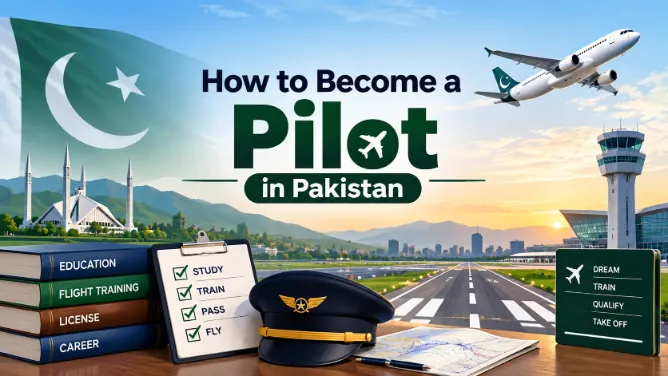
Step-by-Step Guide to Becoming a Pilot in Pakistan
Step 1: Complete Your Education
Students normally begin their aviation journey after completing secondary education.
If your goal is to become an airline pilot, completing Intermediate/A-Level education is a sensible route because it gives you a stronger academic foundation and keeps university and aviation-related options open.
Subjects such as:
- Mathematics
- Physics
- English
- Computer Science
can be useful for understanding aviation concepts, although students should check the admission requirements of their chosen flying school.
Some university aviation programs have their own admission criteria. For example, UMT’s 2026 BS Professional Flight Technology program lists a minimum of 45% in Intermediate/A-Level or equivalent, along with other admission requirements.
Step 2: Meet the Age Requirement
The minimum age depends on the licence you are applying for.
For example, current Rawalpindi Flying Club information lists:
- SPL: 16 years
- PPL: 17 years
- CPL: 18 years
These should be treated as licensing/training requirements to verify with the current PCAA rules and your selected school before enrollment.
Step 3: Pass the Aviation Medical Examination
Medical fitness is one of the most important requirements.
For professional commercial flying, students should expect to need a Class 1 medical certificate.
This examination is important because pilots must be medically fit to safely perform their duties.
Depending on the medical assessment, areas such as the following may be evaluated:
- Vision
- Hearing
- General physical health
- Cardiovascular health
- Neurological fitness
- Other conditions relevant to flight safety
It is wise to complete the required medical assessment before investing heavily in flight training.
Step 4: Learn Aviation English
English is extremely important in aviation.
Pilots need to communicate effectively with:
- Air traffic control
- Other pilots
- Flight instructors
- Ground personnel
- Airline operations teams
Current flying-school requirements in Pakistan emphasize the ability to speak, read and understand English.
Students should therefore work on their listening, speaking and technical-English skills from the beginning.
Step 5: Obtain Your Student Pilot Licence
After meeting the applicable requirements, you can begin the initial pilot training process and obtain the necessary student authorization.
Your flying school will guide you through the required documentation, medical certification, ground school and licensing process.
Step 6: Complete Ground School
Before and alongside flight training, you need to study aviation theory.
Ground-school subjects can include areas such as:
- Air law
- Aircraft general knowledge
- Navigation
- Meteorology
- Human performance
- Flight planning
- Communication
- Principles of flight
- Operational procedures
These subjects provide the theoretical foundation needed to operate an aircraft safely.
Step 7: Begin Flight Training
This is where classroom knowledge is applied in an actual aircraft.
Under the supervision of qualified instructors, students learn skills such as:
- Aircraft control
- Takeoff procedures
- Landing
- Circuit flying
- Navigation
- Emergency procedures
- Radio communication
- Solo flying
- Cross-country flying
The required flying hours depend on the licence and training route.
How Many Flying Hours Are Required to Become a Pilot?
There is no single number that applies to every pilot-training route.
The required hours depend on whether you follow a modular or integrated course and which licence/rating you are pursuing.
A current PCAA-related licensing document specifies 200 hours for a modular CPL course or 150 hours for an integrated CPL course as the aeronautical-experience requirements cited in that document.
Meanwhile, individual training organizations may structure their programs differently. For example, Karachi Aero Club currently advertises an integrated CPL/IR program with 180 hours of minimum flying training.
Therefore, students should not assume that every flying school will advertise exactly the same number of hours. Always compare the school’s current program with the applicable PCAA licensing requirements.
Step 8: Obtain a Private Pilot Licence
The PPL is an important stage in the pilot-training pathway.
At this stage, students develop their basic flying skills and gain experience operating an aircraft.
For students ultimately aiming for commercial aviation, PPL training provides the foundation for more advanced training.
Step 9: Complete Commercial Pilot Training
After meeting the applicable requirements, students progress toward the Commercial Pilot Licence.
Commercial training is more advanced and includes additional theoretical and practical requirements.
Rawalpindi Flying Club currently lists its CPL course as an approximately 10-month course with a minimum of 110 hours following its prescribed syllabus, excluding previous PPL experience.
This illustrates why students should distinguish between course hours at a particular school and the total aeronautical experience required for licensing.
Step 10: Get an Instrument Rating
An Instrument Rating (IR) is an important qualification for professional pilots.
Instrument flying teaches pilots to operate under conditions where they cannot rely solely on outside visual references.
For an aspiring airline pilot, instrument training is particularly important because airline operations routinely involve instrument flight procedures.
Some integrated programs combine CPL and IR training. Karachi Aero Club, for example, currently offers an integrated CPL/IR course.
Step 11: Complete Multi-Engine Training
Airline pilots normally need experience and qualifications associated with multi-engine aircraft.
After completing the required basic training, a pilot may pursue multi-engine training and the relevant rating/endorsement according to the applicable licensing requirements.
This prepares the pilot for more complex aircraft operations.
Step 12: Apply for Pilot Jobs
After obtaining the required licence, ratings and experience, pilots can start looking for professional opportunities.
Possible career areas include:
- Commercial airlines
- Charter companies
- Flying schools
- Corporate aviation
- Cargo operations
- Aerial work
- Flight instruction
However, holding a CPL does not automatically guarantee an airline job.
Airlines can impose additional requirements involving:
- Total flying hours
- Instrument rating
- Multi-engine experience
- Medical certification
- English proficiency
- Airline-specific assessments
- Simulator assessments
- Type rating
- Age and experience criteria
How Much Does It Cost to Become a Pilot in Pakistan?
The total cost of pilot training can be substantial and varies significantly between flying schools and training routes.
There is no single fixed nationwide price because the final cost can depend on:
- Aircraft hourly rates
- Number of hours flown
- Fuel costs
- Instructor charges
- Ground-school fees
- Examination fees
- Medical examination
- Licence fees
- Accommodation
- Repeat flights
- Weather-related delays
- Additional training
- Instrument rating
- Multi-engine training
For example, UMT’s current 2026 BS Professional Flight Technology information lists PPL and CPL flight-training charges of Rs. 48,000 per hour, while its university program has a separate academic fee structure.
This demonstrates why prospective students should request a complete written fee estimate rather than asking only for the admission fee.
Typical Expenses to Consider
| Expense | May Include |
|---|---|
| Admission | Registration/enrollment |
| Ground School | Classroom instruction |
| Flying | Aircraft + instructor hourly charges |
| Medical | Required aviation medical |
| Exams | Knowledge and licensing examinations |
| Licence | Applicable licensing charges |
| Study Material | Books, manuals and charts |
| Instrument Training | IR-related training |
| Multi-Engine | Aircraft/rating training |
| Accommodation | If studying away from home |
How Long Does It Take to Become a Pilot?
The duration depends on the training route, weather, aircraft availability, student progress and the licence being pursued.
Some flying schools advertise programs lasting around 10–18 months for particular CPL routes. Rawalpindi Flying Club currently lists an 18-month CPL-related program in its current course information, while its CPL page describes a 10-month course structure.
Therefore, students should ask the academy for a realistic completion timeline rather than assuming that every student will finish in exactly the same number of months.
Best Subjects for Becoming a Pilot
There is no need to choose an aviation-specific school subject at an early stage.
However, students can benefit from studying:
Mathematics
Mathematics helps with:
- Navigation
- Distance calculations
- Fuel calculations
- Speed
- Time
- Flight planning
Physics
Physics provides useful knowledge about:
- Forces
- Motion
- Pressure
- Energy
- Aerodynamics
English
English is particularly important because aviation communication and much of the technical material are conducted in English.
Can Girls Become Pilots in Pakistan?
Yes. Women can pursue professional pilot careers in Pakistan provided they meet the applicable education, medical, licensing and training requirements.
The career should be approached based on the individual’s interest, qualifications, medical fitness and professional goals rather than gender.
Can I Become a Pilot After FSc?
Yes. FSc can be a suitable educational background for aspiring pilots.
Students from FSc backgrounds may already have useful preparation in mathematics, physics and other science subjects.
However, admission requirements depend on the particular flying school or university program.
Can I Become a Pilot After ICS or ICom?
Potentially, yes, depending on the requirements of the specific training organization and licence pathway.
Students should check the current admission and licensing requirements before enrolling.
If a particular university or flying school requires specific subjects, you may need to satisfy those requirements separately.
Is Good Eyesight Necessary to Become a Pilot?
Good vision is important, but students should not automatically assume that wearing glasses makes a pilot career impossible.
The relevant question is whether you meet the applicable aviation medical standards.
Instead of relying on general advice about eyesight, obtain the appropriate aviation medical assessment before making a major financial commitment to training.
Is Becoming a Pilot Difficult?
Pilot training is challenging because it requires students to combine theoretical knowledge with practical skills.
You need to be comfortable with:
- Studying technical subjects
- Learning aviation regulations
- Understanding weather
- Navigation
- Mathematics
- Aircraft systems
- Radio communication
- Maintaining concentration
- Following safety procedures
The profession also requires discipline and continuous learning.
What Skills Should a Pilot Have?
A successful pilot needs more than good flying technique.
Important qualities include:
- Decision-making
- Communication
- Situational awareness
- Discipline
- Concentration
- Teamwork
- Leadership
- Calmness under pressure
- Technical understanding
- Time management
These skills become increasingly important as you progress toward commercial aviation.
Career Opportunities After CPL in Pakistan
After obtaining the appropriate qualifications and experience, pilots may pursue careers in different aviation sectors.
Airline Pilot
Airline flying is one of the most popular goals for professional pilots.
Flight Instructor
Experienced pilots can pursue the necessary instructor qualifications and teach new students.
Charter Pilot
Charter operators may provide private or corporate transportation services.
Corporate Aviation
Some companies employ pilots to operate business aircraft.
Cargo Aviation
Cargo operations provide another possible professional pathway.
Aviation Training
Pilots with appropriate qualifications and experience can move toward instructional and training roles.
Important Things to Check Before Joining a Flying School
Before paying a large amount of money to a flying academy, carefully verify:
- Whether the organization has the required regulatory approval.
- Which licences and ratings are included.
- The total expected flying hours.
- Aircraft type and availability.
- Aircraft hourly charges.
- Instructor fees.
- Medical requirements.
- Ground-school charges.
- Examination and licence fees.
- Expected completion time.
- Whether additional hours may be required.
- What happens if weather or aircraft maintenance delays training.
This can prevent unpleasant financial surprises later.
FAQs
What is the minimum age to become a pilot in Pakistan?
The minimum age depends on the licence. Current Rawalpindi Flying Club information lists 16 for SPL, 17 for PPL and 18 for CPL. Always confirm the current applicable requirements before enrollment.
Which qualification is required to become an airline pilot?
For a professional airline career, you generally need a Commercial Pilot Licence and additional qualifications, ratings and experience required by the airline and applicable aviation regulations.
Can I become a pilot after FSc?
Yes. FSc is a suitable educational background for many aviation pathways, although individual flying schools and university programs can have different admission requirements.
How many flying hours are required for a CPL?
The requirement depends on the training route. A PCAA-related licensing document cites 200 hours for a modular CPL course and 150 hours for an integrated course, while individual approved programs may have their own published training structures.
How much does pilot training cost in Pakistan?
There is no single fixed cost. It depends on the flying school, aircraft hourly rate, number of hours, licence, ratings and additional training. Students should obtain a complete current quotation from the flying school.
Do I need perfect eyesight to become a pilot?
Not necessarily. What matters is whether you meet the applicable aviation medical standards. An aviation medical examination should be completed before making a major investment in training.

i wanna know all procedure to get admission to become a pilot and knoe im a student of second year